If you’re about to establish or grow your business in the UAE, then the first question to come to your mind will be whether your business requires you to register for VAT or not. Even though some businesses are mandatorily required to register for VAT, there are many other businesses that have an opportunity to register voluntarily.
Differentiating between both types of VAT registration is very important because it’s not just about being compliant with the FTA but is also about making sound financial decisions. In this article, we will discuss the difference between mandatory VAT registration and voluntary VAT registration.
Understanding VAT Registration in the UAE
VAT is a 5% consumption tax levied on all products and services offered in the UAE. Companies that are eligible according to the registration criteria set out by the FTA should register for VAT, collect taxes from clients if necessary, submit VAT returns, and keep appropriate records.
Mandatory vs. Voluntary registration is mainly based on the taxable income of your company.
What Is Mandatory VAT Registration?
The need for VAT registration arises from those organizations which exceed the threshold level fixed by the FTA.
You’re supposed to register for VAT, if:
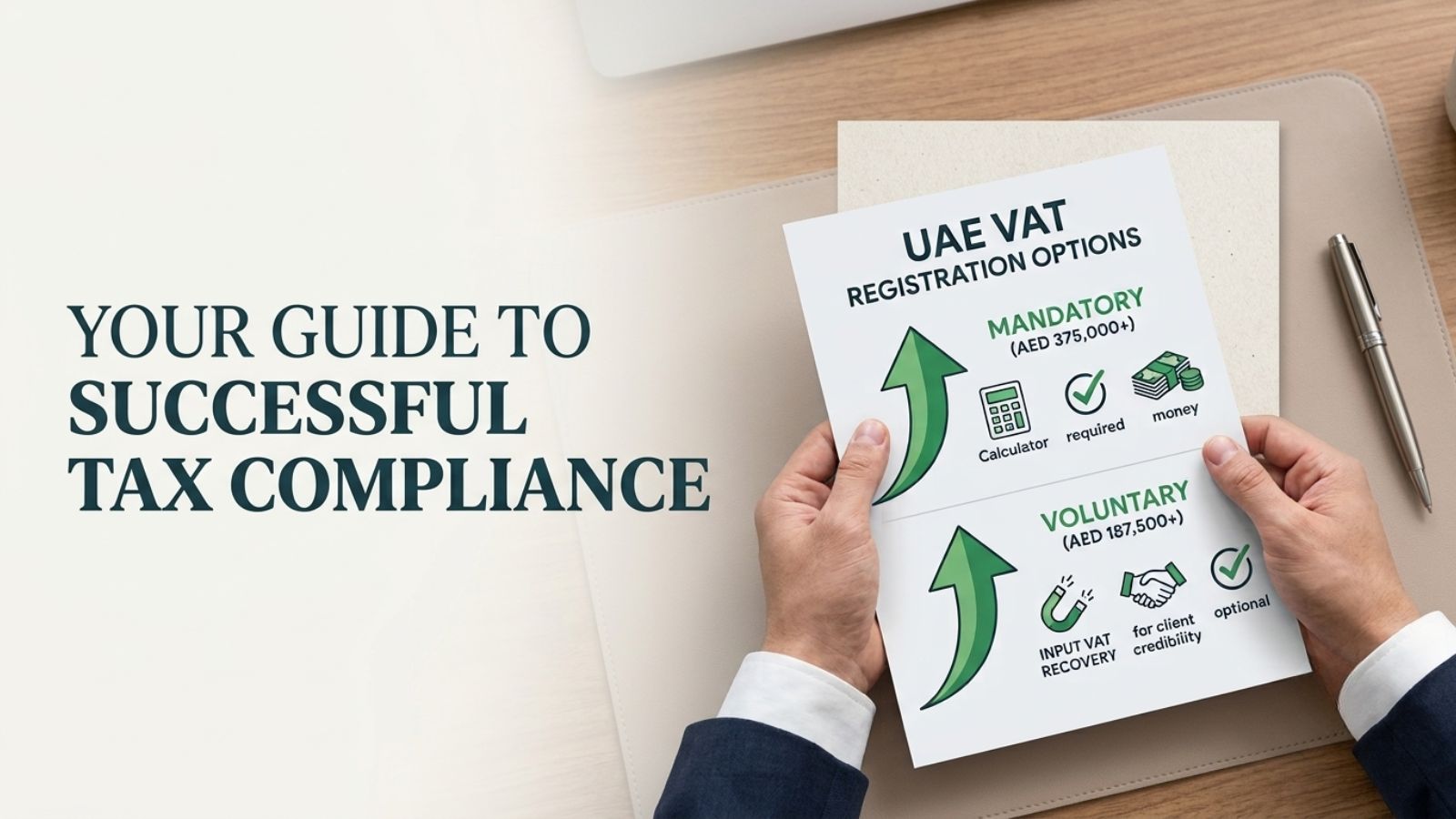
- You’ve made taxable supplies above AED 375,000 in the past 12 months, or
- You expect to make taxable supplies above AED 375,000 within the coming 30 days.
Note: Upon reaching either of the two thresholds above, there is no choice but to register for VAT. Delay in registration might cause further complications, such as late registration penalty of upto AED 10,000 and late return filing of upto AED 1,000 for the first offense( and AED 2,000 for repeated delays within a 24-month period).
What Is Voluntary VAT Registration?
It is possible to choose to register for VAT if the business has not yet reached the compulsory threshold and qualifies under a lower threshold requirement.
You can register voluntarily once your total taxable supplies or total taxable expenses exceed a threshold of AED 187,500.
Although the process of registration is voluntary at this level, many businesses prefer to register themselves as this offers them several business advantages.
Mandatory vs Voluntary VAT Registration: A Quick Comparison
| Mandatory Registration | Voluntary Registration |
| Required by law | Optional |
| Applies after taxable supplies exceed AED 375,000 | Available once taxable supplies or expenses exceed AED 187,500 |
| Failure to register may result in penalties | No penalty for choosing not to register (if below the mandatory threshold) |
| Businesses must comply with all VAT filing requirements | Registered businesses have the same VAT compliance obligations |
While the registration trigger differs, both types of registration carry the same ongoing responsibilities once approved.
Which Option Applies to Your Business?
The right answer depends on your current revenue and future business plans.
You should mandatorily register if:
- Your taxable revenue is currently more than AED 375,000.
- Your projected revenue will cross the threshold within the next month.
- You’re legally required to comply with FTA requirements.
You may consider voluntary registration if:
- Your taxable supplies or business expenses are more than AED 187,500.
- You need to recover the VAT paid for your inputs because you are spending a lot on business activities.
- Your clients prefer dealing with VAT registered businesses.
- You expect growth in your business soon.
Benefits of Voluntary VAT Registration
However, many businesses feel that it is better to wait until compulsory registration applies. Voluntary registration, however, does come with its own set of strategic gains.
Some of them include:
- Claiming eligible input VAT: This involves recovering VAT paid on qualifying purchases made by the business.
- Building credibility: Most corporate clients will favor a VAT-registered supplier over an unregistered one.
- Future proofing: You will get time to adjust your business accounting and internal processes before the business grows.
- Ease in compliance: Rather than rushing to register once the business exceeds certain limits, you will have time to set up your VAT system.
Voluntary registration can provide long-term operational benefits to startups and growing SMEs.
Responsibilities After VAT Registration
This is regardless of whether you are registering on a voluntary basis or on a mandatory one as your responsibilities will still be the same.
If you are registered you will be expected to:
- Apply VAT where necessary.
- Provide VAT compliant invoices.
- Keep accounting records.
- File VAT returns according to the deadline set.
- Keep the proper financial records.
Voluntary registration does not relieve you of any of the above duties.
Common Mistakes Businesses Make
VAT registration can be a straightforward process, yet businesses often make avoidable mistakes that can lead to delays or compliance issues.
Examples of such errors include:
- Assuming that all newly formed organizations must register right away.
- Failing to meet the requirement for mandatory VAT registration due to lack of regular monitoring of revenues.
- Confusing taxable revenues with total revenues.
- Delayed VAT registration after having reached the point of legal eligibility.
- Entertaining a misconception about Free Zones not being required to go through the VAT registration process.
Get the Right VAT Registration Approach with Certified Tax Consultant in the UAE
Deciding on whether to opt for mandatory or voluntary VAT registration isn’t much about choice, but about knowing where your business stands currently and what its future holds.
When your taxable supplies are above AED 375,000, then it is compulsory for you to register for VAT. When your taxable supplies have exceeded AED 187,500, voluntary registration will bring in numerous advantages for you including recovery of input VAT, improved reputation and so forth.
Want to navigate tax requirements with professional expertise? Our vat consultants in Dubai can help you with the complexities of VAT registration while helping you stay compliant. Book a free VAT consultation with our tax experts to get a VAT registration roadmap.