For years, the UAE has been seen as a prime destination for new businesses offering new possibilities in growth, a supportive business tax environment, a strategic address, and so on.
But a coveted business location like the UAE doesn’t come without tax responsibilities and financial requirements. Among these, VAT registration represents an important step in maintaining compliance and preventing penalties that could cost your business time and money.
With that being said, the process isn’t the same for all companies, and the registration requirements can look different. Thus, navigating it with a tax consultant early on can make your VAT journey easier and much more compliant.
This guide will help you learn about VAT registration for your newly established company in the UAE.
What is VAT and How it Works?
VAT is a consumption tax charged on most of the goods and services in the UAE. Rolled out in 2018, the standard VAT rate now stands at 5%. All registered businesses are responsible for collecting VAT from customers and remitting it to the Federal Tax Authority (FTA).
Upon registration, you will get a Tax Registration Number (TRN) for your business, which you need to include in all of your tax invoices and VAT documents.
Does Your Company Need to Register for VAT?
Not all businesses will have an automatic requirement for registration. The requirements vary based on your taxable turnover.
Mandatory Registration
The requirement for VAT registration would apply to those businesses:
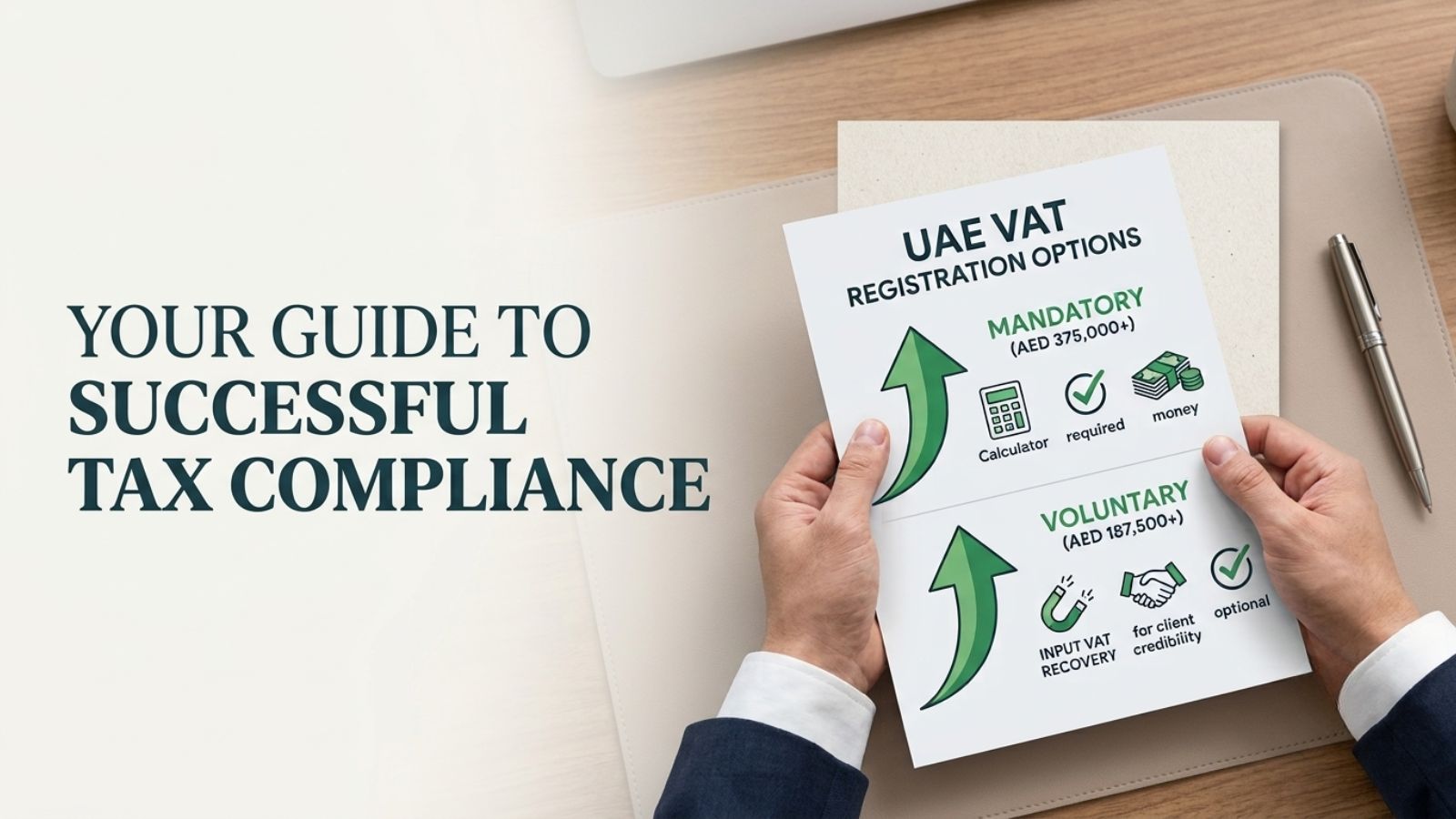
- Has taxable supplies of above AED 375,000 in the previous 12 months,
- Expects to have taxable supplies of above AED 375,000 in the coming 30 days.
Voluntary Registration
Voluntary registration can be advantageous for growing businesses as it gives them an opportunity of reclaiming eligible input VAT on business expenses. It also helps them in presenting a more established image to clients and suppliers, increasing their credibility.
There may also be a possibility of voluntary registration in case of:
- Taxable Supplies exceeding AED 187,500.
- Expenses exceeding AED 187,500.
Do Free Zone Companies Need VAT Registration?
It is a common misconception that a firm operating within UAE Free Zones doesn’t need VAT registration due to exemption status. However, firms operating within Free Zones might still be eligible for VAT registration based on various criteria including business operations and turnovers.
Therefore, whether your firm operates within designated or non-designated Free Zones, it should consider its VAT obligations based on its business model.
Documents Required for VAT Registration
Having all the documents sorted out prior to applying will help to make the process faster. In most instances, you will require:
- Trade license
- Certificate of incorporation
- Memorandum of association (MOA)
- Copy of passports of business owners or authorized signatories
- Emirates ID (if applicable)
- Banking details of the company
- Turnover/Revenue information
- Details of business operations
- Customs registration details (if applicable)
Additional documents may be required based on the structure or operation of your business.
Step-by-Step VAT Registration Process
Step 1: Register for EmaraTax Account
First, create an EmaraTax account, the UAE’s official tax portal. Ensure that your account is verified using the credentials provided.
Step 2: Fill out your Tax Profile
Fill your tax profile with the legal information such as company name, license details, contact details and authorised personnels’ details. Make sure the data is in conformity with your company details.
Step 3: Apply for VAT Registration
Navigate to the VAT registration feature and initiate your application process. The portal will help you fill each section.
Step 4: Provide Details of Business
In the following fields, provide the following information:
- Natures of business operations
- Owner details
- Registered address
- Importing/exporting activities
Step 5: Submit Financial Details
Provide information about your taxable turnover, expected income and importing/exporting details. This information will be used to determine if you have the right to register for VAT.
Step 6: Attach Required Documents
Upload all required documents in readable format. Make sure that:
- Your trade license is valid.
- Business names are consistent in all provided documents.
- Documents uploaded are clear and complete.
Step 7: Review and Submission
Thoroughly check each part of your application form before submitting it. Even slight mistakes regarding the details of the firm or its finances may cause you further inquiries from the FTA.
Upon the completion of the submission process, an application number will be given to you to track your progress through the application process.
Step 8: Get Your TRN
Upon approval of your application, the FTA will issue you a Tax Registration Number (TRN) and a VAT Registration Certificate.
What Happens After Registration?
VAT registration doesn’t mark the end, but the start of the whole process of fulfilling your VAT obligations as a company. After registering, you’ll be required to fulfill these:
- Charge VAT where applicable.
- Issue VAT-compliant tax invoices.
- Maintain accurate financial records.
- File VAT returns within the prescribed deadlines.
- Retain supporting documentation for audit purposes.
- Keep all necessary documentation that can be used for further verification.
Common VAT Registration Mistakes to Avoid
A majority of the errors and delays in registrations can be avoided by being well-prepared for them. These are some of the typical errors:
- Waiting too long after exceeding the registration threshold.
- Submitting inaccurate turnover estimates.
- Uploading incomplete and out-of-date documentation.
- Entering inconsistent company details on various documents.
- Assuming that Free Zones companies do not need to pay VAT.
Get Your VAT Registration Done By Vat Consultants in the UAE
VAT registration is an integral step in the growth of any business in the UAE. Regardless of whether registration is compulsory or optional, following the proper process ensures that your firm remains compliant and minimizes the risk of penalties imposed by the Federal Tax Authority (FTA). Seeking guidance from experienced VAT Consultants in Dubai can help businesses navigate registration requirements, maintain compliance, and avoid costly errors throughout the VAT lifecycle.